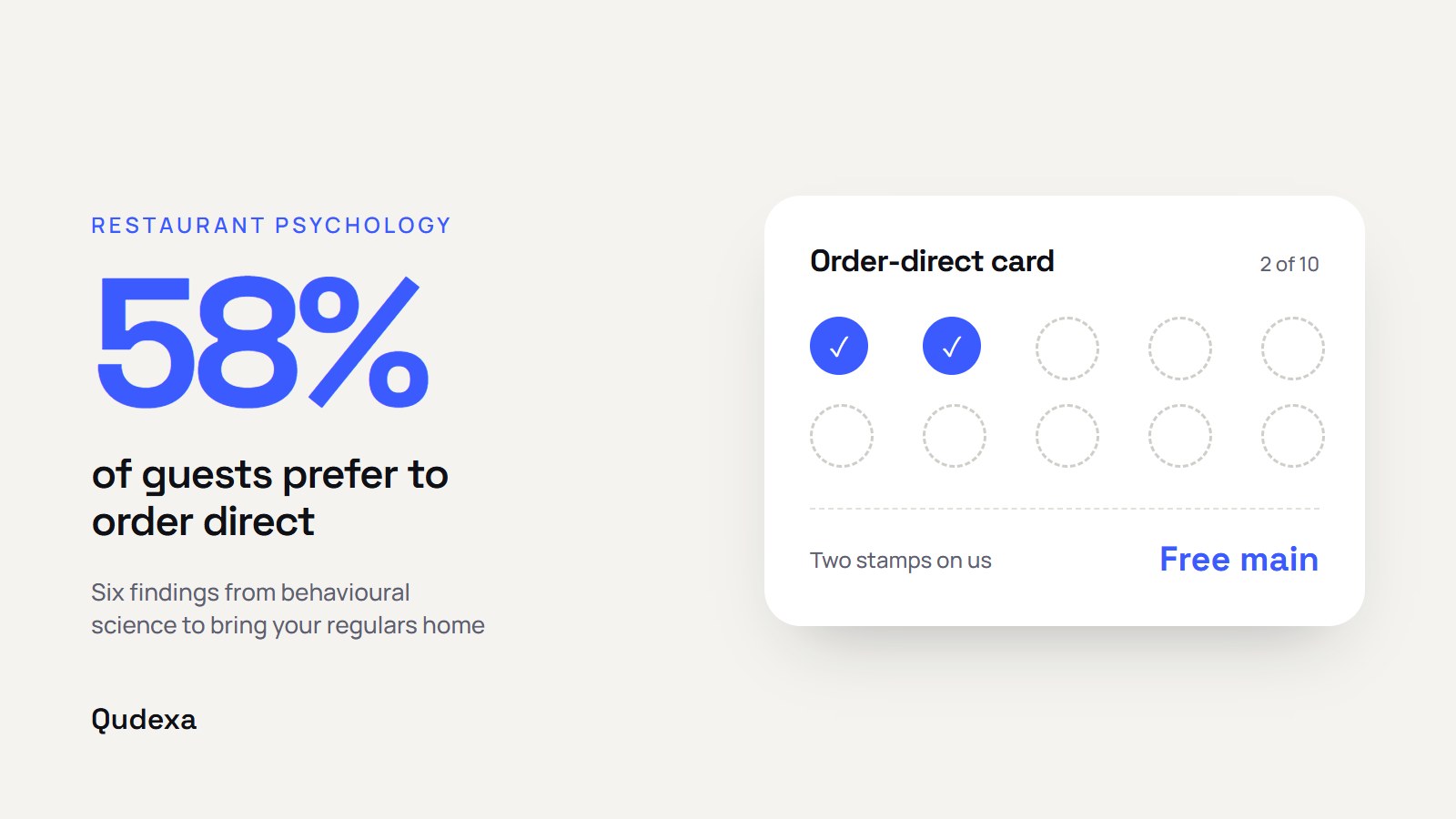
Your regulars do not order through delivery apps because they love the apps. They order there out of habit: the app is already on the phone, the card is saved, and the last order is one tap away. Most of them would actually rather order from you. In NCR Voyix's 2025 Customer Experience Report, 58% of US customers said they prefer to order delivery through a restaurant's own app or website (Restaurant Dive, January 2025).
So the job is not to argue anyone out of the apps. It is to make ordering direct the easier, more rewarding habit. Behavioural science has studied exactly that, and the six findings below turn into things you can do this week.
Key Takeaways
- Guests use delivery apps mostly from habit and convenience, not loyalty; most say they would rather order direct.
- A new habit needs the same cue every time and a couple of months of repetition, so put your ordering link in front of regulars on every order.
- Give people a head start (a loyalty card with stamps already filled) and a small gift first; both are backed by field experiments.
- Make the direct menu feel easy: favourites first, one-tap reorder, and prices shown simply.
- Stay honest: real savings and real gifts build trust, fake urgency breaks it.
Why do regulars keep ordering through the apps?
Because the app removes effort, and people repeat what is effortless. When NCR Voyix asked the people who prefer ordering direct why, 65% said convenience, 50% said it is easier to customise their order, and 36% said they earn loyalty points (Restaurant Dive).
Read that list again: convenience, control and rewards. None of them is "the food is cheaper on the app". If your own ordering page is as quick as the app, lets guests customise properly and rewards them for coming back, you remove every reason they listed. The rest is helping the new habit form.
Build the new habit with the same cue, every time
A habit forms when the same action follows the same cue, again and again. In a study at University College London, volunteers repeated a new daily behaviour in the same situation, and it took on average 66 days for it to become automatic (Lally and colleagues, European Journal of Social Psychology, 2010; summary by the British Psychological Society). The researchers also found that missing one day did not undo the progress.
What to do:
- Put a card with a QR code in every delivery bag and pickup order: "Order direct next time, same food, straight from our kitchen."
- Add the same link to your Google Business Profile, your Instagram bio and your receipts, so the cue appears wherever guests already look.
- Keep it going for at least two months. The first few weeks feel slow; that is normal for habits.
If your Google profile is not set up for orders yet, our Google Business Profile checklist for restaurants walks through it.
Give them a head start on rewards
People work harder towards a goal they have already started. Joseph Nunes and Xavier Drèze tested this at a car wash: one group got a loyalty card needing 8 stamps, the other a card needing 10 stamps with 2 already filled in. Both needed exactly 8 more washes. Yet about a third of the head-start group earned their free wash, compared with roughly one in five of the others (Journal of Consumer Research, 2006; summary at Knowledge at Wharton). The authors call it the endowed progress effect.
What to do:
- Offer a loyalty card that counts direct orders only, and start every regular on it with two stamps "on us".
- Show the progress on the order confirmation: "2 of 10, your free main is getting closer."
- Remember that loyalty points were one of the three reasons guests gave for ordering direct. A visible card is that reason, made concrete.
Give a small gift first
People feel a pull to return a favour, even a small one. In a restaurant field study, servers who gave diners a piece of chocolate with the bill received larger tips than servers who gave nothing, and the way the sweet was offered changed how big the effect was (Strohmetz, Rind, Fisher and Lynn, "Sweetening the Till", Journal of Applied Social Psychology, 2002; abstract at Cornell eCommons). This is reciprocity.
What to do:
- Put a small extra in app orders from regulars, a dessert, a side, a drink, with a handwritten "thanks for coming back" and the QR card from step 1.
- Make the gift genuinely free and given first. "Free dessert if you order direct" is a deal; a dessert in the bag before you ask is a gift, and gifts are what create the pull.
Show what the app is really costing them
People feel a loss more strongly than an equal gain. Daniel Kahneman and Amos Tversky called this loss aversion in their 1979 work on prospect theory (Econometrica, 1979), and it is one of the most studied ideas in behavioural economics.
Many restaurants raise their prices on delivery apps to cover the commission. If you do, your regulars are already paying more than they need to, and a loss is more motivating to point out than a saving.
What to do:
- On the QR card and your website, show the difference plainly: "Same order, less on our website", with a real example from your menu.
- Only claim what is true. If your app and direct prices are the same, talk about what guests get instead: the loyalty card, the gift, faster updates straight from the kitchen.
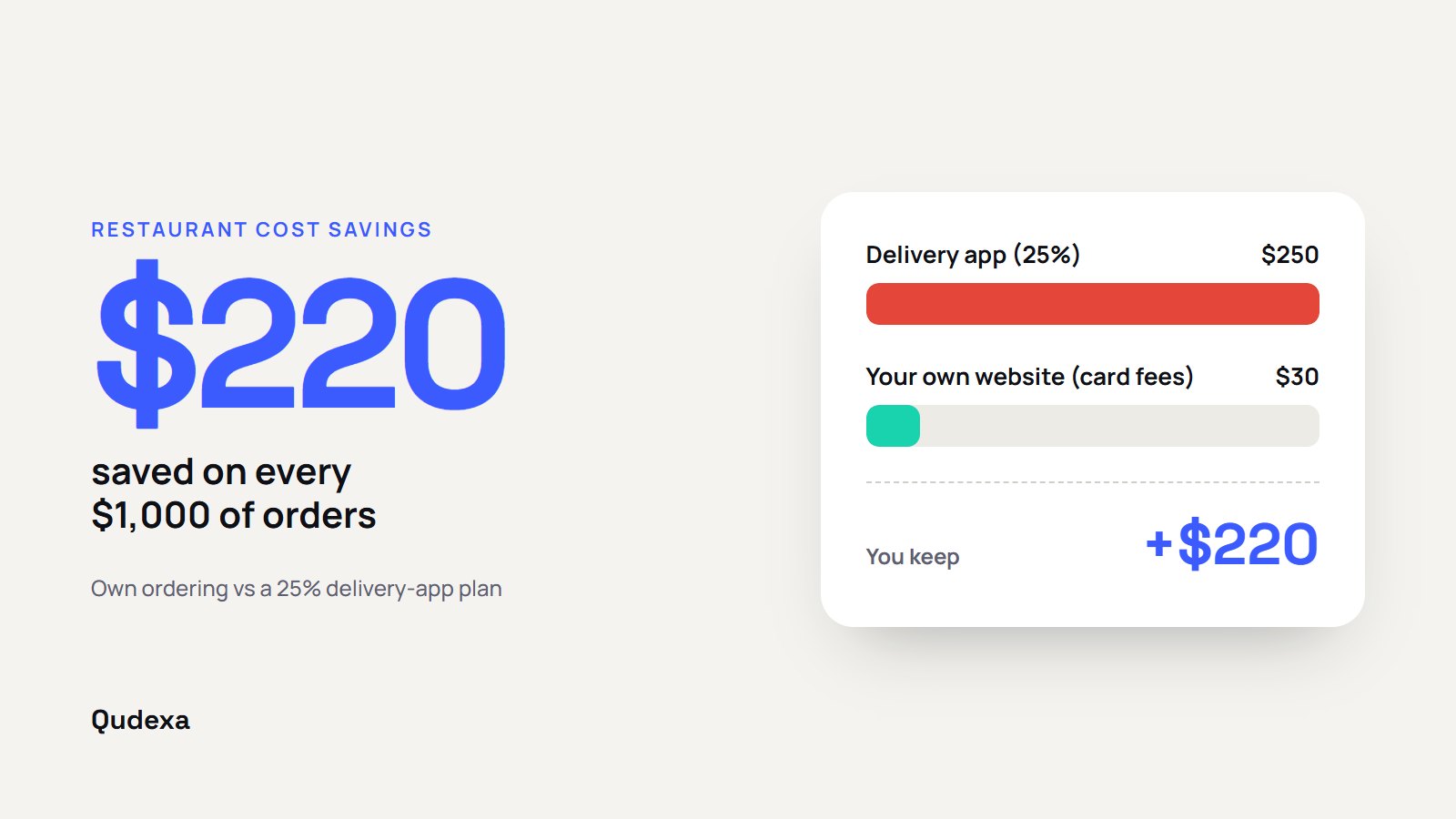
How much the commission costs you is a separate question, and it is usually bigger than owners expect; our guide on how much a restaurant saves by taking its own orders works through real numbers.
Make ordering direct feel effortless
Every extra decision is a small reason to give up. In a famous grocery-store study by Sheena Iyengar and Mark Lepper, a display of two dozen jams drew more people, but a display of only six led to far more purchases: about 30% of the people who stopped at the small display bought a jar, against about 3% at the large one (Journal of Personality and Social Psychology, 2000).
Be careful with this one: later studies found that "too much choice" does not always backfire, and it depends on the situation. The safe lesson for a restaurant is narrower and very practical: make the first steps simple.
What to do:
- Open your ordering page on "Regulars' favourites" or the guest's last order, not on the full menu.
- Offer one-tap reorder and saved addresses, so ordering direct is as fast as the app.
- Keep customisation easy to reach. It was the second reason guests gave for ordering direct.
Show prices the calm way
How a price looks changes how it feels. In a Cornell study at a Culinary Institute of America restaurant, guests whose menus showed prices without dollar signs spent on average $5.55, about 8%, more than guests whose menus used them (Cornell Chronicle, 2009). The researchers suggest that a currency sign reminds people of the "pain of paying".
It was one study in one restaurant, so treat it as a small polish, not a strategy.
What to do:
- On your own ordering page, show prices as plain numbers (12, 18.5) where your platform allows, and avoid long rows of prices aligned in one column that invite comparison shopping.
- Never hide fees to make a price look calm. A surprise at checkout undoes every gain above.
What not to do
Behavioural science works best when it makes the honest choice easier. A few tactics backfire with regulars, because regulars notice:
- Fake urgency, like countdown timers that reset or "only 2 left" when it is not true.
- Hidden fees that appear at checkout.
- Leaving the apps entirely. They are good at one thing: bringing you new guests. Keep them for that, and move the repeat orders home.
Frequently asked questions
How long does it take to move regulars to ordering direct?
Plan for a couple of months. Habit research suggests new routines take around two months on average to become automatic, so keep the same cue (the QR card, the link) in front of guests on every order for at least that long.
Do I need my own app, or is a website enough?
For most independent restaurants a fast ordering website is enough to start. In the NCR Voyix survey, guests who prefer ordering direct were split evenly between a restaurant's own app and its website, so a good website covers half of that group from day one, and an app can come later.
Should I offer a discount for ordering direct?
A small, regular reward usually works better than a one-off discount: a head-start loyalty card and an occasional gift build the habit, while a discount mostly rewards a single order.
Will this work for a small restaurant?
Yes, it often works best there, because regulars know you. Every tactic here costs little: printed cards, a loyalty card on your site and a small gift in the bag.
The short version
Regulars order through apps out of habit, not loyalty, and most would rather order from you. Give them the same cue every time, a head start, a small gift and a page that is as easy as the app, and the new habit forms on its own.
You need an ordering page you own for all of this to work: a loyalty card, saved favourites, one-tap reorder and no commission. That is what we build and run for independent restaurants. See how it works and what it costs, or read why taking your own orders pays off.
Sources
- NCR Voyix 2025 Customer Experience Report, via Restaurant Dive (January 2025)
- Lally, van Jaarsveld, Potts and Wardle, "How are habits formed", European Journal of Social Psychology (2010); summary by the British Psychological Society
- Nunes and Drèze, "The Endowed Progress Effect", Journal of Consumer Research (2006), DOI
- Strohmetz, Rind, Fisher and Lynn, "Sweetening the Till", Journal of Applied Social Psychology (2002), Cornell eCommons
- Kahneman and Tversky, "Prospect Theory", Econometrica (1979), DOI
- Iyengar and Lepper, "When Choice is Demotivating", Journal of Personality and Social Psychology (2000), DOI
- Yang, Kimes and Sessarego, "$ or Dollars", Cornell Center for Hospitality Research (2009), via the Cornell Chronicle